Perspectives is an opportunity for Fellows and others to share their ideas in short, accessible essays. IPE/BC Fellows hold a range of views and interests relative to public education.
Do school board elections matter?
September 19, 2022
By Patti Bacchus
Do school board elections really matter? That depends. Too often B.C.’s school boards are ineffective and they’ve lost the power to levy taxes or bargain directly with the employee groups on key issues. Many simply rubber stamp management recommendations and happily cash their modest pay cheques and do little to represent their constituents at the board table. One could fairly argue that school boards are the worst form of governance, and they are, with the exception of all the others.
But yes, democratically elected school boards matter. They matter because effective trustees who take the role seriously and courageously can make a real difference in improving, or even protecting, educational opportunities and supports for students. We need far more of those kind of trustees, and it’s up to all of us to find them and support them, whether we have kids in the system or not.
It’s often said that public education is the cornerstone of democracy. It is, and it’s also essential to a healthy, prosperous and just society.
Vibrant and effective school boards, where respectful debate is informed and encouraged, and where all voices are permitted to be heard and access to trustees is open, are a key component of a high-functioning and successful school system. By most measures, Canada’s public schools are remarkably successful and produce good results in return for what the public invests in them. Do school boards have anything to do with this? I believe they do, at least in some cases.
Unfortunately, many B.C. school boards are moving away from that model with increasingly restrictive codes of conduct that limit trustees from speaking out and engaging with those they’re elected to serve. Many have erected rigid barriers that discourage and restrict public  participation. Too many take direction from their management teams, instead of the reverse. Far too much of the public’s business —and school board business is the public’s business — happens behind closed doors or in private emails instead of in public meetings, where it belongs.
If they want to matter to the public, school boards need to give themselves a hard shake and decide whether they want to do the important work of transparently representing the public in decision-making, or keep fussing about each other’s decorum or conduct as they head down the road to extinction.
We get our chance to vote for school trustees this October 15, when we elect mayors, city councillors and school trustees. It’s worth taking the time to learn about who is running and what they stand for, and make sure those who truly care about public education get elected to office.
What do school boards do?
School boards have a co-governance relationship with the provincial government over the public education system. Curriculum is set provincially, and decisions about class sizes are negotiated at the provincial level. The B.C. School Act broadly states school boards are “responsible for improvement of student achievement in the school district.”
In practice, one of the most important functions of school boards is hiring and overseeing their superintendent of schools, who is also the district’s chief executive officer (CEO). The superintendent is the only employee who reports directly to the board, and is responsible for carrying out the board’s directions and ensuring the district and schools are run in compliance with the School Act and collective agreements with employee groups, all while staying within tight budgets. A superintendent who understands the values and priorities of the board, and is committed to carrying them out, is critical to a successful school district.
It’s also the job of elected school trustees to represent the public in decision making and advocating for the needs of their district. Some do this very well. Others do not.
In addition to trying to “improve student achievement”, elected school boards are responsible for developing a wide range of policies and making decisions about opening or closing schools (in reality, government mostly decides if school are opened, via whether or not they decide to fund new schools) and which choice or special needs programs go where. They also set “catchment” boundaries, which dictate which school students have priority access to in their neighbourhood, although there’s no guarantee being in catchment means you get a space in your local school.
Trustees who succumb to government and management pressure to close schools and sell off school lands, which we’ve seen in many B.C. school districts, can cause lasting harm to their districts if they don’t carefully consider the long-term implications of such decisions.
School trustees also approve their annual budgets, and ideally, give direction to management regarding budget priorities.
Who can be a school trustee?
Any Canadian citizen who is over 17 and has lived in B.C. for at least six months is eligible to run, with a few exceptions, including school district employees, who can not run in the district the work in. From there, voters decide, unless there are no other candidates and the candidate is acclaimed.
What’s the job really like?
Some trustees show up for monthly meetings and cast a few votes and go home. They may attend a few school events throughout the year.
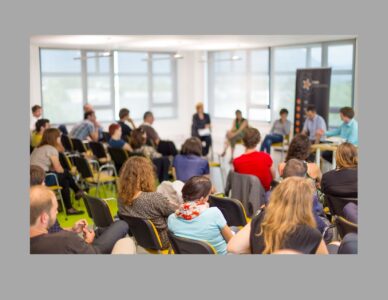
Fortunately that’s a minority. I served eight years on the Vancouver School Board (VSB), and was chair for six of those. Many days started before dawn with live radio interviews and reading and replying to hundreds of emails. I would visit schools and attend meetings during the day, and spend afternoons preparing for evening meetings. My district had two formal board meetings a month in my day, along with five standing committees that met monthly, various briefing workshops and other internal and external committees where I represented the board as a liaison trustee, and frequent community events and speaking engagements.
Many trustees hold day jobs and simply can’t commit the kind of time others can, and smaller districts usually have fewer meetings and time demands.
I also spent a lot of time advocating for the needs of my district through the news and social media, and in in-person meetings, which I believe all trustees should do.
It was a tough role to be in, but I felt honoured voters gave me the opportunity to do it. A vibrant, well-resourced public-education system is key to addressing many of the challenges we face. Trustees can play a significant role in supporting and protecting it.
What to look for in trustee candidates
Those of us who keep an eye on B.C. School Boards often shake our heads at the ineffectiveness and dysfunction of some of them. Too many simply rubber stamp management recommendations and sign off on inadequate budgets, leaving students without the support they need to succeed.
Advocacy is hard work and can feel futile, but it does make a difference. Each year I chaired the VSB I made sure we presented a compelling case for increased funding to the provincial finance committee when it did its annual public consultation. My board collaborated with parents and employee groups to raise awareness about the need to invest in schools and to support the people who work in them.
We took time to communicate clearly to the public about how various provincial government policies were affecting classrooms and the supports and programs available for students. We worked alongside parents and other advocates to secure hundreds of millions of dollars in provincial funding to replace or upgrade seismically unsafe schools (yet, there are still many waiting for funding). We brought in ground-breaking policy updates to make schools safe and welcoming for students, staff and families of all gender identities. We made a difference.
As trustee elections approach, it’s important to find and support candidates who are passionate about the importance of public education

and are willing to stand up for it. We need trustees who understand the role and are willing to use it effectively, not just warm a seat at the board table.
That’s not always easy, but if they’re not willing to do the hard work they shouldn’t be running.
Look for school trustees candidates who are committed to making themselves accessible to their constituents and opening as many channels of communication as possible. If you’re going to represent the public, you need to hear from them. Trustees need to remember that once they’re elected, especially if they’re told they shouldn’t meet with groups of individuals, speak to reporters or engage with the public and social media (this, apparently, has been happening in several school districts).
School boards are an endangered species
School boards are a creation of provincial legislation and can be abolished. It’s happened in Nova Scotia, New Brunswick and Quebec. Prince Edward Island tried getting rid of them, and now they’re bringing them back. Manitoba came very close to eliminating them, but backed off. For now.
I confess they are times I feel we should scrap ours, like when the Victoria School Board took it upon themselves to essentially oust two elected trustees — who were known for speaking out on behalf of students, parents and Indigenous communities — from the board table for the remainder of their term. That’s a huge overreach: voters should be the ones to decide who sits at the table, not other trustees.
Trustee elections are fast approaching. Don’t take elected school boards for granted. Find and support candidates who are passionate about public education and are willing to roll up their sleeves and fight for it. It matters.
Patti Bacchus is an IPE/BC Fellow and dedicated public education advocate and commentator. She was the Vancouver School Board’s longest serving chairperson (2008-2014). Patti believes that a strong and well-resourced public education system is key to a healthy and just society.
 The early warning indicators are already here. Community members without teacher qualifications are placed in some classrooms. A lack of teachers on call are available to fill in behind teachers away because of illness. Staff lose their planning time as they are pulled in to cover thousands of classes without their regular faculty member. Students with disabilities are sent home, deprived of their right to education because their specialist teachers are required to cover classes for missing colleagues.
 The BC government has recognized these other demands and has provided funding for increased training positions in health care, technology, and trades. However, education has been an afterthought, if a thought at all.
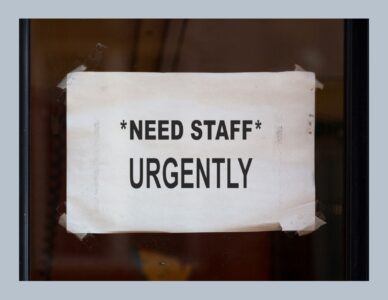 It is past time for the government to recognize that public education, like health care, requires urgent attention to staffing shortages.
 decline of nearly ten percent in government grants between 2006 and 2020. Annabree shone the light on the fact that this decline has led to risky decisions to seek varied sources of private dollars, which in turn has deprioritized the academic mission in favour of sponsored research. Additionally, it has fed the phenomenon of a burgeoning administration rather than a much needed increase in faculty to keep pace with the growth in student enrollment. Further, Annabree pointed out the folly in relying on revenue from international students to bolster budgets, as was made abundantly clear when the COVID pandemic diminished that revenue stream.
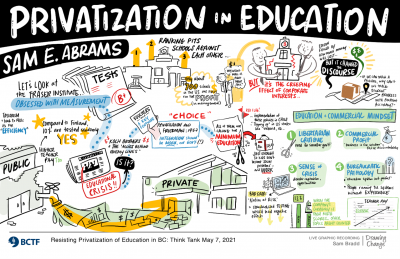
 on public education has been in significant decline. In 2001, BC allocated 2.8% to public schools while by 2021, it had reached an all-time low of 1.7%. Had the percentage even just remained steady throughout this period, there would have been an additional $2 billion more in school board budgets. Excessive cost-cutting, as Andree stated, is baked into the current structure of the funding model. We see this at play in yet another round of budget preparation this spring as numerous school boards are considering cuts once again, a reality that was simply not addressed in the provincial budget tabled and touted by the province in February.
 adequate support leads to exclusion not inclusion. She has direct experience with the issues and, in her role with BCEdAccess, has spoken to many parents who feel their kids are not welcome in public schools. Due to underfunding and lack of appropriate supports, many students are being excluded from public schools and the full and appropriate range of learning experiences that should be available to them. BCEdAccess has been
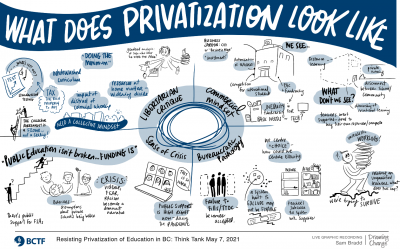
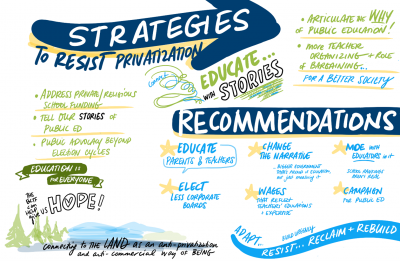
 Education is on the verge of a similar crisis. The teacher shortage is reaching crisis proportions, universities are crumbling, and provincial governments are treating educators as if they are the problem rather than partners in revitalization. Investment in K-12 education in BC is at historic lows, just 1.6% of GDP in 2019, half what it was in 1982. This panel will bring together senior leaders in the education sector to discuss the looming crisis facing our sector, as well as help us begin to explore what our hopes and dreams for a revitalized education sector could look like.”

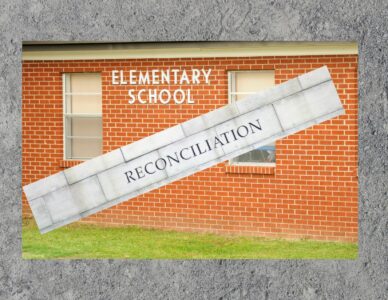 as an act of reconciliation,” recently sponsored by the BC Teachers’ Federation. The panel, moderated by BCTF President Teri Mooring, also included Peggy Janicki, who holds a seat designated for an Aboriginal teacher on the BCTF Executive Committee, and Brian Coleman, the chairperson of the BCTF Aboriginal Education Advisory Committee. Teri opened the session by describing official name changes as small but important steps in reconciliation and decolonization. She reflected on the impact of names on our understanding of people, place, and history, asking, “Whose lives and history do we honour and whose do we erase?”
 After nearly a year of work, the committee came to a unanimous decision to propose that the school be named Skwo:wech, which is the Halq’eméylem word for “sturgeon.” The name is particularly significant given the connection with the Fraser River and the importance of sturgeon to Indigenous communities who traveled up and down the river.
 board stated, “It’s a name that we’re proud to move forward with, that came from a process that involved a great deal of collaboration and learning already, with more opportunities to build on for years to come.”