Perspectives is an opportunity for Fellows and others to share their ideas in short, accessible essays. IPE/BC Fellows hold a range of views and interests relative to public education.
Claims about education costs mislead by ignoring social and educational changes
by Larry Kuehn
A claim about the history of funding of public education by UBC professor Jason Ellis is seriously misleading by omitting the context of changes that have taken place in education over the past fifty years. He has published an article in which he claims there has been an increase in spending on BC public education between 1970 and 2020 that he calculates as 250%. This increase is described as “astounding” according to Ellis, as quoted in a UBC press release, although he doesn’t use that phrase in his academic article.
Unfortunately, the article is an overly simplistic comparison of gross expenditures inflation adjusted with the number of students without looking at the changing expectations of education over five decades, the way the public schools have adjusted to meet those, and the very real costs of those changes. Ellis ignores the complexity when he says, “After all, if we are talking about how much we spend on K-12 schools, it surely matters how far those dollars stretch. That is mainly a question of how many students public schools need to educate at any given point in time.” (Ellis, p. 104) In fact, costs are a factor of not just how many students you have, but also the changing and diverse nature of student needs and what you offer them in the way of service and conditions.
The study chooses an arbitrary date as the baseline, without identifying the context of the system at that time and the rationale for improvements in conditions and thus expenditures since then. The language of the article reflects a bias toward “cost control” and “fiscal discipline” and an opposition to the collective bargaining rights of teachers. The rationale for the article in the end seems to be a challenge to those who see the limitations on education expenditure as based on neoliberal ideology when the facts actually support claims of those who see neoliberal policies as having a negative impact on educational expenditures.
The educational conditions in the baseline of 1970
The choice of a baseline can have a significant effect—if one chooses a low point, then the increases seem greater–and 1970 was a low point for several reasons.
The number of students grew rapidly in the 1960s, but the system did not keep up with that growth. The W.A.C. Bennett Social Credit government had a priority on building dams for hydro and other infrastructure development rather than schools and in the late 1960s had introduced policies, including a school referendum system, to limit school district expenditures.
Double shifts were common, where two schools were run within one building, an early shift until mid-day and another in the afternoon until evening. Many schools had to be built at this time, but Ellis acknowledges that the amount in his 1970 baseline does not include capital costs of building schools, but those cost are included for the period after 1974.
Class sizes were large as well. B.C. had the largest classes in Canada in 1970, except for Newfoundland. The BC Teachers’ Federation ran a campaign at the time to limit class sizes to 40, an indication of the conditions, a situation that not only teachers but also parents would not find acceptable now. There were significant reductions in pupil-teacher ratios and class sizes in the 1970s, catching up with the limitations that existed in 1970. None of these improvements in the 1970s were the result of teachers’ collective bargaining since the legal framework at the time only allowed for negotiation of salaries and benefits.
The school system in 1970 was also much more elitist and exclusionary. While now we are not satisfied if fewer than 90% of students complete graduation, it was half that fifty years ago. Students with special needs were not included, few programs existed for students whose first language was not English, many Indigenous students were in Residential “Schools,” and many of the Indigenous students in the public system were marginalized and actively discouraged from staying after age 16. Being inclusive in addressing all these needs takes people and resources. Very few would be satisfied with the education system we offered in 1970. In fact, many would require more of our current system, not expecting that this could be achieved on 1970 funding levels.
Many teachers who retired before 1970 lived on pensions that left them in poverty. Governments in the previous fifty years had been unwilling to provide the financing for an adequate pension system, a situation that was finally addressed in the 1970s and beyond—at a necessary cost.
The teaching force in 1970 had much lower overall levels of qualifications that have been continually increasing over the decades. In 1970 many teachers at the elementary level had entered teaching with one year of university and a year of teacher education. Most of them increased their qualifications over time, often with many years of summer university courses. In contrast, now very few enter the profession with less than a degree as well as teacher education. At least a third of current teachers have a master’s degree or a diploma beyond their bachelor’s degree and teacher education. These qualifications reflect an ability to deal with a much more complex set of educational needs—and legitimately get reflected in increased costs.
 Yes, costs have increased, as they have in most things. The percentage they have increased depends not just on what the costs are, but also the baseline on which you are making the comparisons. If you choose the baseline that is a low point, it will appear that the increase is greater—and after 1970 was a point when a lot of pent-up demands were increasing on the public education system in B.C.
The conservative framing of the article
Some of Ellis’s language draws from a source frequently referenced in the article, Thomas Fleming, a conservative B.C. education historian. Fleming’s ideal of education is based in what he calls the “imperial” age of education in B.C. when education policy was determined by the education officials in the ministry (then Department) of education. This handful of men (and they were always men) could determine policy for the system and carry it out through a network of inspectors. It could keep costs under control and keep the system narrowly focused on academic purposes, not the broader social demands.
Fleming acknowledged that pressure was growing in the system in the 1960s to expand the mandate and the services of the schools, even as the enrolment was growing dramatically, and women were becoming restive over their subservient role in the system. Fleming defines 1972 as the break point in the system with the election of the New Democrat government and the active role of the BCTF in the election. The ministry officials lost control and the system was open to influence by politicians, teachers through the BCTF and what he calls special interests—parents making demands for their children and social activists calling for marginalized groups to have their needs met. All these new demands on the system would require more resources.
Calling for a return to a narrower, less inclusive education system doesn’t have any credence. The public does not want the system to do less, but to do more of whatever particular concern they have. This is confirmed every time budget limitations lead to services being cut. Fleming tried to influence a call for a narrower system focus on the academic as an editor of the 1988 Royal Commission on Education Report, but was frustrated by the lack of response of the system to that recommendation. If a direct call to cut what the system does would not work, another approach is to call for reduced costs so it is not able to do as much.
Here is where Ellis picks up Fleming’s approach using the language of “rein in educational spending” (p. 102); “cost control” (p. 102, 110, 111, 117, 118); “controlling spending” (p. 102, 113, 114); “impose spending limits” (p. 118); “fiscal discipline” (p. 113). Fleming is particularly critical of the BCTF influence in public education, beginning at the point that it became active in the 1972 election, and particularly after achieving collective bargaining rights in 1988 and Ellis adopts Flemings negative perspective on teacher bargaining. Fleming’s ideal was the “old boys network” of the education department that many BCTF leaders were a part of before the change in the organization about 1970.
Although Ellis contends that “saying that spending is up considerably is not saying it should not have increased. It is not saying that spending should not rise further in the future.” (p. 118) In only focusing on how much the expenditures have grown and not addressing the purposes of the increases or the services provided, and calling the increases “astounding”, Ellis plays into those who would use cost control to narrow educational offerings and who will use the headlines from his study to support their aims.
Reference
Ellis, Jason. (2021) “A Short History of K-12 Public School Spending in British Columbia, 1970-2020.” Canadian Journal of Educational Administration and Policy, 196, 102-123.
Larry Kuehn is a member of the IPE/BC Board of Directors and chair of the Research and Programs Committee. He is a research associate for the CCPA and retired BCTF Director of Research and Technology. He has written extensively on education matters including funding, globalization, technology and privacy.
 learning; by employers for preparing a skilled work force; and by judicial authorities for preparing law-abiding citizens. In the current context (of pandemic), educators have been asked to take on accountability for the physical and mental health of students as well. In short, schools have many constituencies they serve and for many diverse reasons, but most of these groups have very little agency to inform educator practices. Instead, government has largely taken on that authority.
 This separation of schools and communities is a problem. The provincial government has worked to address the problem in part through the establishment of Parent Advisory Committees and regular parent satisfaction surveys. Here too, however, power sharing between the Province and parents remains largely symbolic, and has in many ways been used to further constrain educator authority. Across all aspects of governance, in BC the Provincial government has centralized almost all authority regarding the public education system.
 politicians, and anyone expressing an interest in education in BC). In 42 communities across BC, in large and small cities, rural and urban settings, and throughout the province by e-mail, the panel solicited testimony from British Columbians. The process was focused on aspirational outcomes for BC students and so focused around four over-arching questions: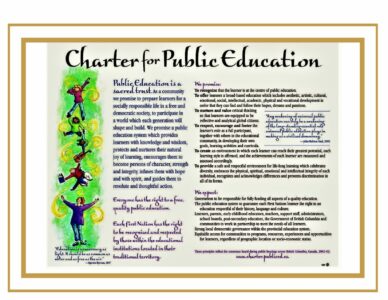
 and community members who participated in the hearings. From a school library in Gibsons, to an auditorium in McBride, to a community hall in Haida Gwaii, to high school classrooms in Fort St John, and many places and spaces in between- each session was highly engaging and deeply meaningful.
 responsible life in a free and democratic society, to participate in a world which each generation will shape and build.”
 The BCTF, after a discussion and debate that was not without controversy, decided to fund the initiative. Many teachers were not convinced that their resources should be used in this way. Why, they asked, should teachers pay for a commission would be independent of the Federation? Still, the project was eventually enthusiastically approved.
 mandate of the Charter process. Rather, the panel determined to draw out the principles behind the pain. They decided to pose a number of questions to the participants in every hearing:
 Looking back to last March, Bryn recalled worrying about whether the resilience of students, teachers and parents could sustain itself for the long road ahead. However, even with very difficult challenges, shared leadership and strength have grown, with everyone working together in support of students, families, and the community. “This embodies what public education is all about- that it’s for the common good,” said Bryn. His hope is that distributed leadership with connections to community continues to flourish, post COVID-19.
 Jamie urged recognition of the Indigenous world view in schools, noting that Indigenous people are keepers of knowledge fundamental to the creation of a compassionate, harmonious society and to the planet’s very survival. She highlighted the need to recruit more Indigenous teachers and welcome Indigenous elders into classrooms, and expressed her concern that an over-emphasis on academics means that children are missing many of the basic life skills needed to survive and live in harmony with others. “We’re teaching kids to be scholars; we’re not teaching them to be community members,” she said.
 “Every teacher sees the difficulty in it now and every parent sees the limitations,” said Julia. She noted that attendance at virtual meetings and workshops is high, but there is a passivity that comes with engaging online. “There is something about the physicality that leads to memorable professional development experiences and enhances the way we learn and make decisions together,” Julia observed.
 Privacy is not only a key element of freedom, but key to the development of autonomy as a person. Young people need the space to explore and develop, without the pressure of surveillance that will affect them the rest of their lives.
 protecting privacy and includes provisions that personal data not be held on servers outside of Canada. This is protection against invasive access provided by legislation elsewhere, particularly the U.S., where most data are held—although this protection was waived by Ministerial Order during the pandemic.
 and expertise that should be available to the education system. The Privacy Commissioner should provide more guidance for the system on complying with the legislation and draw on international expertise available.
 One such feature is school choice. “Choice” takes place in a variety of ways: the open catchment areas; allowing and increasing public funding of private schools; allowing school fees; and promoting niche schools and academies. With only limited opposition (from parents, teachers and school trustees) “choice” policies have changed the nature of BC’s public school system. The impact of these changes is that we are moving from a more comprehensive, equitable, neighbourhood and community oriented, publicly administered school system, towards a semiprivate, stratified and segregated system in which precious limited resources are increasingly allocated to a privileged minority.
 Yet another form of school choice is the Academy, or niche program. There are sports academies, and arts academies, but also academic academies such as International Baccalaureate programs, honours programs, and challenge programs. These
  specialty programs often have competitive enrolment processes, and often require the payment of school fees (typically $2000 – $5000, but as much as $17,000/year). Thus, they are available only to a small subset of students.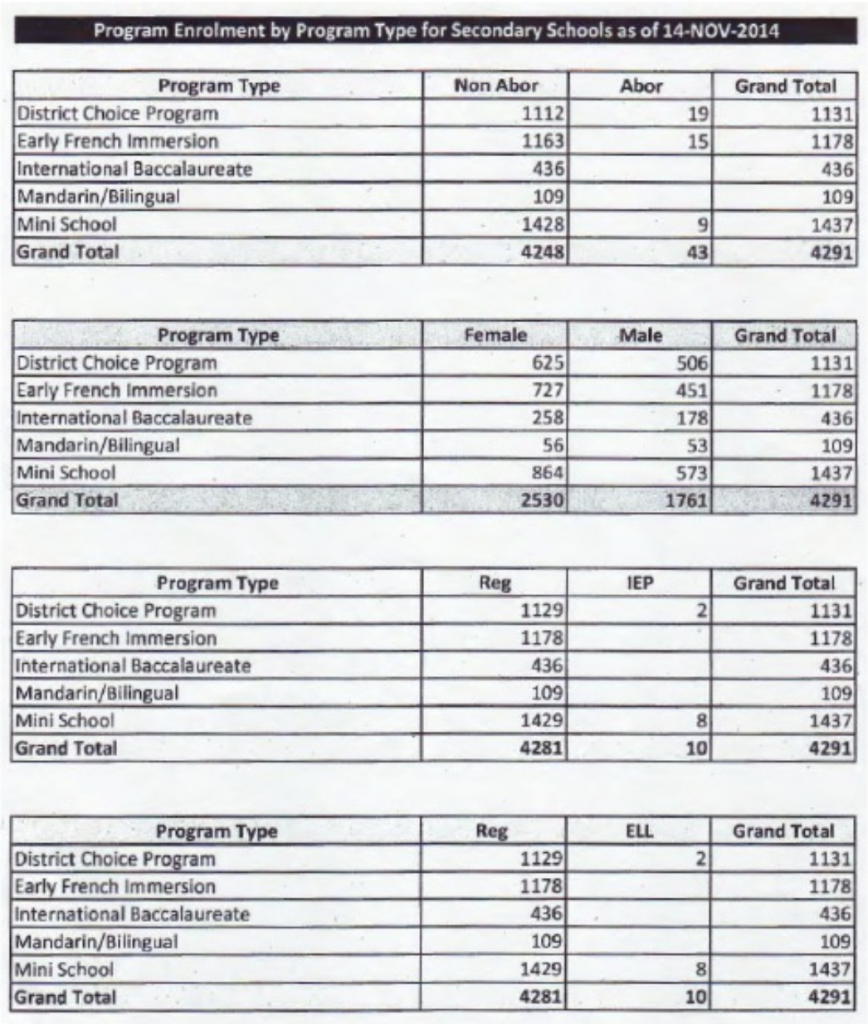
 The most successful colonizer has been Google. A recent report indicates that Google’s G-Suite for Education is being used by half the teachers and students in the U.S. Canada is fast approaching the same level of use. It includes a range of free software tools that can be used by students and teachers—word processing, presentations, spread sheets and the like. G-Suite incorporates “Classroom,” an integrated learning management system that keeps track of grades, attendance and more. And, of course, YouTube is linked to student use.
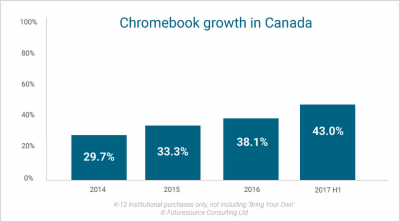 It is less expensive than other computers because much of what it needs to operate is supplied by Google in the cloud—operating software, applications and memory. No need to build those into the computer. According to market reports, Chromebooks make up the majority of all computers sold to schools in the U.S. and are marketed globally.