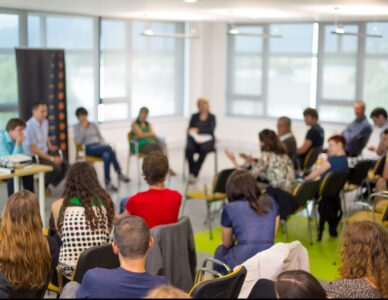
On March 6, 2025, in conjunction with our Annual General Meeting, IPE/BC held a forum titled, “Inclusionary practices in BC schools: Are we making progress? We’re grateful to our panelists Hilary Thompson, President of Inclusion BC, Tamara Taggart, President of Down Syndrome BC, and Tracy Humphreys, Executive Director of BCCPAC and past ED of BCEdAccess, and our moderator, Patti Bacchus, IPE/BC Board member. Don’t worry if you weren’t able to attend; you can watch a video of the forum and read all about it.
News
Inclusionary practices in BC schools: Are we making progress?
March 12, 2025
Moira Mackenzie
On March 6th, IPE/BC held a public forum asking the question, “Are we making progress on inclusionary practices in BC schools?” Thanks to our panelists, Tamara Taggart, President of Down syndrome BC, Tracy Humphreys, Executive Director of BCCPAC and past-ED of BCEdAccess, and Hilary Thompson, President of Inclusion BC, we learned a great deal. And, unfortunately, the answer to our question was a resounding “NO” from all three.
For years, the BC government has had an admirable policy statement on inclusion on the books, but without the necessary funding, supports and services in place, it is in danger of becoming an empty promise, especially to parents/caregivers who have to work so hard to advocate for  their children with disabilities and/or diverse needs. These parents and many others know it’s a system under stress; they and their children regularly and directly experience the impact of teacher and support staff shortages and chronic underfunding. They also know how difficult it is to access the education decision-makers and be heard. And they speak to the fact that placing students with disabilities and/or diverse needs in classrooms without the necessary supports or, as is sometimes the case, in segregated classrooms, serves to stigmatize their children and seriously undermines their ability to succeed.
Further, we learned that it’s not only the children and youth who are stigmatized, it can happen to their parents/caregivers as well, since they are forced to be determined, relentless advocates while also dealing with all the usual demands of parenting. Our panelists, who are all experienced advocates, spoke about the hurdles they and other parents face in trying to access information and be heard. They also know that they are among many, many others in this situation as each of their organization hear from great numbers of parents with similar experiences each year.
As an example, Tamara Taggart shared that Down syndrome BC was interested in finding out more about how the education dollars marked for inclusion were actually being spent. Were they, for example, being diverted to other uses? In communicating with Ministry officials over time, the organization was told that the Ministry doesn’t keep track of this spending and, so, didn’t have an answer. Undeterred, Downs syndrome BC wrote to a sampling of school boards only to be given the same answer- the district didn’t track that spending. It was very frustrating and equally concerning, to say the least.
Tracy Humphreys spoke to the need for school boards to hear the concerns of parents. Too often, access to board meetings and even individual trustees is severely limited. She proposed that trustees make it a practice to include the voices of District Parent Advisory Councils and Parent Advisory Councils at the board table. In the BC School Act, DPACs, which include reps from PACs, are assured of their right to advise the board on any matter pertaining to education in the district and so should be regularly welcomed to share their concerns.
Hilary Thomson was very clear that what we need is “more humans” in the system providing more support. Simply put, placing students in classrooms without supports is not inclusion. Hilary stressed the need to learn from parents and to ask the kids themselves what they need and want.
 Looking back, inclusion first became a government initiative in the 1980s. The Royal Commission on Education report in 1988 and subsequent education School Act revisions mandated the closing of segregated schools and established the requirement that neighbourhood schools were to provide for the success of all children. There was the expectation of significant positive change and, for a time, there were meaningful steps in that direction. But, years of underfunding and the lack of adequate staffing and supports has us seeing inadequate supports as the “norm” and exclusionary practices coming back- reduced time at school, exclusion from certain activities, and, in some cases, even segregated programs and classes.
As our panelists reminded us all, inclusion is a recognized right, not just in BC but on the national and international levels. For example, the, Article 24 of the UN Convention on the Rights of Persons with Disabilities , which was ratified by Canada in 2010, speaks directly to the right to an inclusive education with access to necessary accommodations and supports.
So, given that our education system in BC has been struggling with inclusion, what needs to be done now? Hilary was clear that simply placing students in classrooms without the staffing and support they need is not inclusion. What we need is more humans, she told us, along with the willingness of school districts to better involve and learn from both students and parents. Tamara spoke to the need to eliminate segregation; it breeds discrimination and children and youth carry the painful experiences of segregation into adulthood. Tracy reminded us of how important it is for post-secondary institutionsa to ensure that teacher education courses include a significant focus on inclusionary practices. And, all panelists agreed that education assistants need to be recognized for the information, skills and supports they can provide. Both education assistants and are teachers struggling under staffing shortages, underfunding and impossible working conditions.
 We’d add one more step. We’d encourage everyone to call on each school district and the Ministry of Education and Child Care to hold similar forums with parents/caregivers, support staff, educators and students to learn from their experiences and recommit to fully supported inclusion in all of our public schools.
We’re very grateful to our panelists for sharing their wisdom and experience and for the incredibly important work they undertake. We also thank our very skilled panel moderator, Patti Bacchus, and all of our participants online and in person.
Click here to watch the forum.
For more reading on inclusion in schools in BC today, we’d recommend:
Advocating for Equity, Report of the Vancouver DPAC Inclusive Education Working Group
Realities of Inclusive Education in Surrey’s Public Schools
BC Ombudsperson’s Investigation into Exclusion of Students from School
Placing a Priority on Public Education
Moira Mackenzie is member of the IPE/BC Board of Directors. She taught in BC public schools for many years, serving as a primary, intermediate, resource ,and learning assistance teacher ,and retired as Executive Director of the BCTF. She feels very privileged to volunteer with IPE/BC and work with others dedicated to quality, inclusive, accessible public education.
You’re Invited…

The Institute for Public Education/BC is pleased to invite you to our upcoming forum:
Inclusionary practices in BC schools: Are we making progress?
IPE/BC director, Patti Bacchus, will be moderating a panel discussion featuring:
- Hilary Thomson, President, Inclusion BC, Region: Lower Mainland/Fraser Valley
- Tamara Taggart, President, Down Syndrome BC
- Tracy Humphreys, Executive Director, BCCPAC and former Executive Director of BCEdAccess
When: March 6th, 7:00 pm.
Where: Room 2200, SFU Harbour Centre, Downtown Campus
515 West Hastings, Vancouver, BC
Click the links below for directions:
Online access to the forum
If you’re not able to attend in person, we hope you’ll join us by Zoom. Please contact us to request the link.
IPE/BC Annual General Meeting
The IPE/BC AGM will follow the forum. Everyone is welcome to stay for the meeting and learn more about our work.
AGM Agenda
- Welcome and introduction of IPE Directors
- Annual Report
- Financial Report
- Election of Directors
- Adoption of amendments to the constitution
6.Feedback from participants
Please don’t hesitate to contact us with your questions or suggestions.
Hope to see you on March 6th!
IPE/BC statement on the firing of the democratically elected Greater Victoria School Board
January 31, 2025
The Institute for Public Education/BC is very concerned that the Minister for Education and Child Care, the Hon. Lisa Beare, has fired the democratically elected Greater Victoria School Board. We recognize that it is essential to engage Indigenous, Black, and other racialized communities in shaping future policies to ensure their experiences in schools are inclusive and safe; however, the firing of a duly elected school board is not a principle that any government in Canada should follow.
This action has serious implications for the role of democratically elected school boards and their ability to respond to community needs and advocate for the public schools and students in their districts. Further it casts a pall over the trustee by-elections scheduled for this spring and the trustee elections set for the fall of 2026. This sends a disturbing message to voters. The low participation in local government elections is already of concern, and this action may well further depress voting rates at a time when democratic engagement is needed more than ever.
As stated by the Canadian Association of School Boards, “School boards are an important part of Canada’s political landscape and represent democratic participation in public education. Governing school boards enable local decision making in response to local needs.”
Additionally, we are worried about the message that the firing of the Greater Victoria School Board sends to students. We believe that it’s very important, especially in a time of increased polarization, for students to learn and practice the skills of dialogue, consensus-building, cooperation and respectful advocacy.
IPE/BC is deeply concerned about the unmet needs in BC’s public schools and, together with many others, has identified the inadequate funding and support for students with diverse and special needs as an urgent issue to be addressed. Our board of directors had expected that this would be a high priority for the new government as well and are dismayed to see that the firing of an elected school board takes precedence.
We call on the Minister and the government as a whole to respect the role of democratically elected boards of education, investing the necessary time and commitment required to resolve differences as they arise, and to turn their attention to the pressing issues in our schools.
On March 4th, the BC government will be tabling its provincial budget. Generally, there is an annual legislative budget consultation that takes place well in advance; however, this year, due to the scheduling of the election, it did not take place. Therefore IPE/BC has taken the initiative of outlining its key education funding priorities in a submission to government. We consider a quality, inclusive, well-supported public education system to be fundamental to a strong democracy and thriving society. While we know there are many pressing needs in our public schools, we have chosen to focus on those that we view as the most urgent priorities. Please share this document with others and join us in calling for public education funding to be a government priority.
Placing a Priority on Public Education
You can also review IPE/BC’s past submissions to the Select Standing Committee on Finance and Government Services here.
IPE/BC has written to BC’s Minister of Education and Child Care proposing a pause on the School Police Liaison Officer program. We believe the province must ensure that schools remain safe, inclusive spaces for all students. As such, we are asking the Minister to:
1. Temporarily suspend SPLO programs to allow for a comprehensive, independent evaluation of their impact on student safety, equity, and well-being.
2. Engage Indigenous, Black, and other racialized communities in shaping future policies to ensure their lived experiences are centered.
3. Prioritize funding for professionals such as counselors, social workers, and restorative justice practitioners to address students’ needs without reliance on police presence.
Our letter is posted for your interest here.
IPE/BC is an independent, non-partisan organization, however we recognize that IPE/BC Fellows and guest authors hold a range of views and interests relative to public schools, education issues, and the political landscape in BC. Perspectives is an opportunity for Fellows and others to share their ideas in short, accessible essays.
The Role of School Police Liaison Officers: Do We Really Need Them?
Sharon O’Dornan
December 11, 2024
Education Minister Lisa Beare has threatened to fire the elected school board of Greater Victoria (SD 61) if they do not provide a revised “safety plan.” It appears that the safety plan must include the reintroduction of the School Police Liaison Officers (SPLO) program.
 In schools, staff work diligently to ensure that programs are effective. Measurable goals are created, data is gathered, and results are reviewed regularly. Reports regarding student progress are generated at prescribed intervals. These reports are shared with parents and relevant school staff, covering everything from classroom achievements to individualized programs such as speech-language therapy. The information is securely, confidentially stored for future reference as needed. The rationale behind this process is clear: if we do not measure our efforts, we cannot determine whether our interventions are truly making a difference.
However, school board chair Nicole Duncan stated (in an interview with Gregor Craigie on On The Island CBC radio, December 10, 2024) that she has received no response to her requests for data and reports regarding the Greater Victoria Police Department’s previous involvement in the SPLO program. Police Chief Del Manak has provided occasional anecdotes about the program, but that is far from the comprehensive data needed to assess its overall effectiveness.
 Schools operate with a great deal of transparency. Classroom teachers provide daily plans that are utilized by themselves or a teacher-on-call. Support staff, such as English Language Learning teachers and contracted specialists like occupational therapists, follow universal referral systems, administer standardized assessments, document observations and provide reports . Caseload information is readily available to school administrators, and priorities are confidentially discussed during school-based team meetings.
Before I retired from my role as an itinerant speech-language pathologist in SD 61, I found it difficult to understand the role of the SPLO. The transparency regarding their schedules and duties was lacking. If I wasn’t clear about why a police officer was standing in the office or walking in the halls, I can only imagine how unclear the students might have been. This lack of clarity raises important questions about whether the program could be contributing to profiling. It feels strange to have a police presence in a public institution without a specific, stated requirement for their involvement. Why, as a society, do we believe that groups of children require a police presence to be safe, especially when there is no concrete data to demonstrate that this approach actually ensures their safety?
 As schools work hard to maintain a safe and supportive environment for students, the question remains: Does the presence of School Police Liaison Officers truly contribute to the safety of our schools, or is it simply an unproven assumption? Without clear data and transparent reporting on the program’s effectiveness, it’s difficult to justify its widespread adoption. Perhaps it’s time for a deeper, more data-driven conversation about how best to ensure the safety and well-being of students without relying on programs that lack measurable evidence of success. It’s crucial that we continue to explore alternative solutions that prioritize student welfare while addressing the complexities of modern school safety.
Sharon O’Dornan retired from the Greater Victoria school district (SD61) in 2020, after a 34-year career as a speech language pathologist. During that time, she worked in the Vancouver, North Vancouver and Victoria school districts.
For further reading on this important and topical issue, see:
What is the alternative to police in schools?
“Relationship Building” and the Normalization of Police in Schools
Victoria School Board says lack of communication upended safety plan
Not everyone is welcoming police officers back to schools
Five reasons why school policy officers may not be the most effective way to prevent violence
Vancouver votes to reinstate the SLO program
Statement of Concern from the Institute for Public Education BC
December 8, 2024
IPE BC is disappointed that former school board trustee and now the Minister of Education and Child Care, Lisa Beare, has chosen to intervene in the work of the Greater Victoria School Board (SD61) by appointing a Special Advisor. This decision undermines the authority of a democratically elected school board and sets a concerning precedent for ministerial overreach.
We acknowledge the importance of safety in schools but emphasize that addressing such concerns requires collaboration, respect for community voices – especially Indigenous voices, and thoughtful consideration of equity and inclusion.
IPE BC urges the Ministry of Education to work constructively with SD61, supporting the board’s autonomy while fostering meaningful dialogue with all stakeholders, including marginalized communities. Democratic governance must remain at the heart of public education in British Columbia.
IPE/BC is an independent, non-partisan organization, however we recognize that IPE/BC Fellows and guest authors hold a range of views and interests relative to public schools, education issues, and the political landscape in BC. Perspectives is an opportunity for Fellows and others to share their ideas in short, accessible essays.
The Impact of the New Rights on the Privatization of Education
Andrée Gacoin
November 25, 2024
The conservative discourses of the new Rights, and their impact on education, was top of mind in October 2024 as BC went to the polls to elect a new provincial government. In Canada, education is the mandate of provincial governments and, while education is not always an  election issue, this particular race was dominated by harmful and hateful rhetoric that sought to control and further privatize education. This included:
-Censoring of classroom materials. In media interviews, as well as the party platform, the Conservative Party of BC critiqued educational materials for being politically biased and promoting (progressive) ideologies.[i] The popularity of this view can be seen in the increase of “book challenges” across Canada. These challenges are when individuals or group seek to remove books from school libraries or restrict them to certain audiences. Books that are inclusive of diverse gender identities and sexual orientations, as well as books by Indigenous, Black and authors who identify as People of Colour have all been challenged.[ii]
-Attacking social justice and rights-based approaches as “indoctrination” and seeking to control teachers’ professional autonomy. The Conservative Party’s agenda built on moral panics that have mobilized parent groups across the province, panics seen in previous elections for school trustees as well.[iii] For example, groups have gathered outside schools, and targeted individual teachers, to protest the inclusion of sexual orientation and gender identity in the curriculum.[iv] Complaints have been made to the Teacher Regulation Branch, a body that governs the professional conduct of teachers, related to teacher’s curricular decisions related to social justice issues.
-Being explicitly anti-union. The Conservative platform focused on terms such as “open procurement” and “qualified” workers and critiqued government for being overly influenced by unions. This is part of a broader fiscal conservatism that promotes reduced government spending, free markets, free trade, and privatization.
–Increased funding for private schools. In BC, many private schools (called “Independent Schools”) receive government funding at either 50% or 35% of their local public school district rate. The Conversative Party of BC argues that private options are necessary because of parent’s concerns about the “ideologies” being taught in public schools.
While the Conservative Party of BC did not ultimately win (barely),[v] they have formed the official opposition and there was overwhelming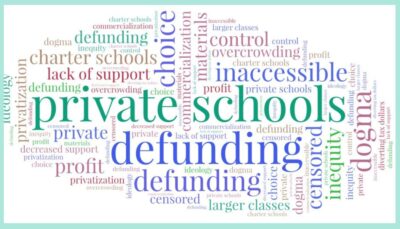 support for the Conservatives in many parts of the province. Their ideas for education are reflected in the ongoing advocacy of right-wing Think Tanks, such as the Fraser Institute, that champion education reforms “to achieve better value for money and improved results for both students and taxpayers.”[vi] Proposed measures include returning to a “back-to-the-basics” curriculum, increasing student testing for accountability, and establishing charter schools in the province.
The political landscape in BC reflects the rise of conservative politics across Canada. In the province of Ontario, for instance, there is a populist provincial leader who has consistently underfunded public education for six years, leading to larger class sizes, decaying buildings, and fewer supports and services for students.[vii] In Quebec, the rise of conservatism can be seen in politicians who openly and proudly push an anti-union agenda and attempt to convince the public that unions are to blame for the failing of public services. This is coupled with xenophobic rhetoric that blames immigrant populations for problems within the province.[viii] Nationally, the leader of the Conservative Party is seeking to be the next Prime Minister of Canada. He is a self-described “champion of a free market,” believes in “limiting government” and posits that schools should “stick to teaching math, reading and writing.”[ix] Public opinion polls indicate that he would win if the Canadian election was held today.[x]
 As illustrated in the case of the BC election, these conservative political parties are linked to the rise of the “parental rights” movement in Canada – a movement that embodies the many links between far-right ideologies and interest in education privatization. In BC, for example, the attacks have been focused on a program called SOGI 123, which supports teachers to make schools safer and more inclusive for students of all sexual orientations and gender identities. Contrary to the arguments of the new Rights, research illustrates the positive impact of this program. A recent evaluation of SOGI 123, done by researchers at the University of British Columbia, found that the program decreased bullying and sexual orientation discrimination for both LGBT+ and also for heterosexual students.[xi] However, conservative groups, taking up the language of “choice” in education, continue to attack the program (and those who teach it) as “indoctrinating” kids and promoting “radical ideologies.”
Across Canada, this “moral panic” becomes a weapon against public education in two key ways. Firstly, it is used as a political rallying call to “take-back” public education, such as by electing morally conservative trustees on public school boards. Secondly, it legitimizes parent “choice” to opt-out of public education and mobilizes this “choice” to increase the privatization of public services.
[i] See for example: https://www.cbc.ca/news/canada/british-columbia/bc-conservatives-election-eductation-policy-1.7351918 and https://www.cbc.ca/news/canada/british-columbia/sogi-123-sexual-education-b-c-election-2024-1.7333988
[ii] https://www.teachermag.ca/post/book-challenges-protecting-diversity-in-our-llcs
[iii] See for example: https://www.comoxvalleyrecord.com/community/courtenay-school-board-trustee-candidate-distributing-anti-sogi-material-1636411
[iv] See for example news coverage, and teachers’ responses, at: https://pressprogress.ca/surrey-teachers-speak-out-against-misinformation-around-2slgbtq-education-in-bc-schools/
[v] 47 seats in the BC Legislative Assembly are needed to form a majority government. The center-left National Democratic Party (NDP) won those 47 seats, just securing the majority. The Conservative Party of BC won 44 seats and the BC Green Party won 2 seats.
[vi] https://www.fraserinstitute.org/studies/k-12-education-reform-in-british-columbia
[vii] See a statement from the Ontario Secondary School Teachers’ Federation (OSSTF) here: https://www.osstf.on.ca/en-CA/news/new-coalition-announces-coordinated-response-to-ford-government.aspx
[viii] See for example: https://cultmtl.com/2024/11/quebec-mna-haroun-bouazzi-accuses-colleagues-of-recurring-xenophobia-polarizing-lie-or-uncomfortable-truth/
[ix] https://www.conservative.ca/pierre-poilievre/
[x] https://nationalpost.com/news/canada/no-trump-bump-liberals-us-election
[xi] See: https://www.saravyc.ubc.ca/2024/10/09/report-evaluation-of-sogi-123-in-bc/
Dr. Andrée Gacoin is the Director of the Information, Research and International Solidarity Division at the BC Teachers’ Federation and an IPE/BC Fellow. Her research focuses on developing a unique, in-depth and contextualized exploration of education in BC from the perspective of teachers. Andrée is particularly interested in using research as advocacy to uphold and strengthen an inclusive public education system.
At IPE/BC we believe that public education is in the public interest. A high quality public school system that is accessible and welcoming to all is essential to a strong democracy and a healthy, equitable, and prosperous society. We expect a great deal from our public schools and, in turn, they need our support. Together we must advocate for the funding, staffing, support and conditions that students, educators, parents, and school communities need. IPE/BC has created a new webpage with resources, contacts and links to help support public education advocacy and we hope you’ll check it out.